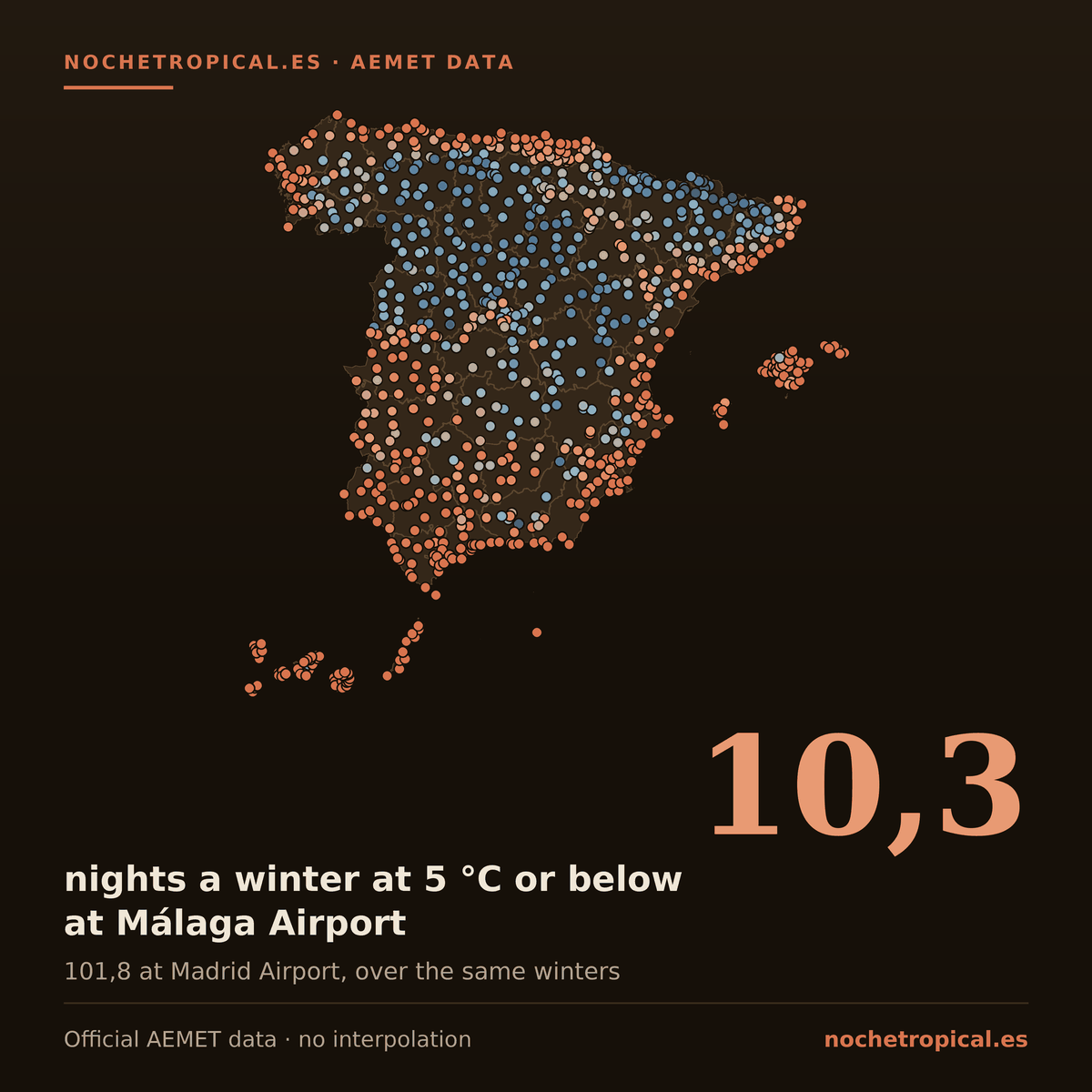
A grey winter back home has its own kind of fatigue: short days, the heating on, weeks without proper sun. “Go south” is the usual answer, but it isn't a precise one. The question here is simpler: on a winter night, how often does it drop to freezing, and how often to 5 °C, the kind of cold at which most people want the heating on?
We used the same AEMET daily records that power the rest of nochetropical.es: every night from 1 November to 31 March, winter by winter, from 2017/18 to 2025/26, at the reference weather station of each city. They are the same figures you can look up town by town in the frost-free towns calculator.
| City · AEMET station | Frost nights per winter | Winters with no frost | Nights ≤ 5 °C per winter | Nights ≤ 10 °C per winter |
|---|---|---|---|---|
| Santa Cruz de TenerifeSta.Cruz de Tenerife · 36 m | 0 | 9 of 9 | 0 | 0 |
| Las Palmas de Gran CanariaLas Palmas de Gran Canaria, Pl. de la Feria · 15 m | 0 | 8 of 8 | 0 | 0 |
| AlmeríaAlmería Aeropuerto · 21 m | 0 | 9 of 9 | 1.0 | 68.9 |
| MálagaMálaga Aeropuerto · 7 m | 0 | 9 of 9 | 10.3 | 77.7 |
| ValenciaValència, Viveros · 13 m | 0 | 9 of 9 | 11.3 | 87.0 |
| AlicanteAlicante-Elche Aeropuerto · 43 m | 0 | 9 of 9 | 17.3 | 103.4 |
| MurciaMurcia · 62 m | 1.2 | 3 of 9 | 29.3 | 108.7 |
| Madrid · Cuatro VientosMadrid, Cuatro Vientos · 690 m | 15.2 | 0 of 9 | 87.4 | 143.8 |
| Madrid · Airport (Barajas)Madrid Aeropuerto · 609 m | 41.0 | 0 of 9 | 101.8 | 144.9 |
Source: AEMET OpenData, daily minimum temperatures, winters 2017/18 to 2025/26 (1 November – 31 March). A frost night is one with a minimum of 0.0 °C or below. A winter only counts if the station has data for at least 90% of its nights. Town–station matching: IGN (CNIG). · nochetropical.es
We judge frost-free one winter at a time, as the calculator does: a winter is frost-free if the station recorded no night at 0 °C or below. At the stations of all 6 coastal cities in the table, every winter measured was frost-free. Murcia is the exception. Frost is only the extreme, though: the nights at 5 °C or below are what separate one mild winter from another.
Santa Cruz de Tenerife and Las Palmas de Gran Canaria are not “mild for Spain”: they are a different climate. At their stations, no night's low fell to 10 °C or below in any winter measured, let alone to freezing. If the aim is not to think about winter at all, this is the group in the table where the data supports it.
Almería Airport recorded no frost in 9 of 9 winters and 1.0 nights a winter at 5 °C or below, fewer than Málaga (10.3), Valencia (11.3) or Alicante (17.3). Among the mainland cities in this table, it has the lowest count.
Málaga Airport recorded no frost in 9 of 9 winters, 10.3 nights a winter at 5 °C or below and 77.7 at 10 °C or below. The Costa del Sol's reputation as a winter destination is consistent with the data.
On this site, Valencia usually appears for its summer: its city-centre station, Viveros, averages about 73 tropical nights a summer. In winter the same station recorded no frost in 9 of 9 winters and 11.3 nights a winter at 5 °C or below. The city that needs an escape from the heat in August needs much less of one in January.
Valencia also shows why the station matters. At Valencia Airport, in Manises, 9 km inland, the figures are 4.7 frost nights and 44.7 nights at 5 °C or below per winter. Same city name, different station, different winter.
Alicante-Elche Airport recorded no frost in 9 of 9 winters, but 17.3 nights a winter at 5 °C or below. The Costa Blanca is mild in winter, but among the coastal cities in this table, Alicante's nights are the ones that get closest to cold.
Murcia sits in the same “warm south-east” as Alicante and Almería, but its station recorded frost in 6 of 9 winters, 1.2 frost nights a winter on average, and 29.3 nights at 5 °C or below, 1.7 times Alicante Airport's count. Murcia lies inland, away from the moderating effect of the sea, which is the likely reason. “In the south” and “on the coast” are not the same claim.
Madrid's Retiro station is not among the stations in our winter series, so the table shows two AEMET stations in the Madrid area: Cuatro Vientos, with 15.2 frost nights and 87.4 nights at 5 °C or below per winter, and Madrid Airport, with 41.0 and 101.8. In the calculator, the municipality of Madrid is matched to the Pozuelo de Alarcón station, 10.7 km away, which gives 48.7 frost nights a winter. This isn't a criticism of Madrid: it's the reference that gives the rest of the list its meaning. Between Madrid Airport's 101.8 nights at 5 °C or below and Málaga's 10.3, the difference is whether the heating goes on most winter nights or on a few.
It is fair to object that 6 °C in Madrid and 6 °C in Valencia don't feel like the same cold. The first explanation that comes to mind is humidity, but relative humidity is a poor guide here. It measures how close the air is to saturation at its current temperature, not how much water it holds. Cold, calm inland air reaches a high relative humidity with very little moisture in it, which is why Madrid gets winter fog and hoarfrost despite being dry; milder coastal air can hold more water and still show a lower percentage. A higher humidity figure does not mean a damper cold.
What more likely makes coastal and inland cold feel different is wind and dew point, and we don't have a daily historical series of either for these stations. So this page, like the calculator, counts only minimum temperature: nights at or below a threshold. We would rather say that plainly than publish a “feels like” figure the data can't back.
In summer, nochetropical.es looks for the places where the night cools down enough to sleep, counting tropical nights: those that never drop below 20 °C. This page runs the same logic the other way round: the same AEMET stations and the same daily minimums, at the other end of the thermometer. The coolest towns to sleep in summer and the frost-free towns to spend winter are the two halves of one idea: natural climate refuges, season by season.
Choose any Spanish town and the temperature at which you would want the heating on at night.
A winter in which the reference AEMET weather station recorded no night with a minimum temperature of 0.0 °C or below between 1 November and 31 March. It is judged one winter at a time, not as an average.
Yes. The figures come from the same AEMET daily records, winters 2017/18 to 2025/26. Choose a town and a temperature in the calculator and you get the same numbers.
Relative humidity doesn't answer that: it depends on temperature, so cold inland air can show a higher percentage than milder coastal air while holding less water. Wind and dew point are the more likely explanation, and there is no daily historical series of them for these stations, so we count minimum temperature only.
This comparison covers eight cities. Any other Spanish town with more than 500 residents, 4,113 in total, is in the frost-free towns calculator, with its reference station, distance and difference in altitude.
From AEMET OpenData, the open-data service of Spain's State Meteorological Agency: daily minimum temperatures at each station. Town data come from IGN (CNIG). The results are published under CC BY 4.0.