Every winter-sun brochure quotes the same kind of number: “Malaga, 17 °C average in January.” An average of 17 °C is what you get from twenty mild days — and it is also what you get from ten days at 24 °C and ten at 10 °C. It does not tell you the one thing you need to know: how many nights you will be switching the heating on.
So we counted. Not averages: nights below 10 °C, days warm enough to eat outside, rainy days, frost nights — station by station, winter by winter. Then we crossed it with the summer.
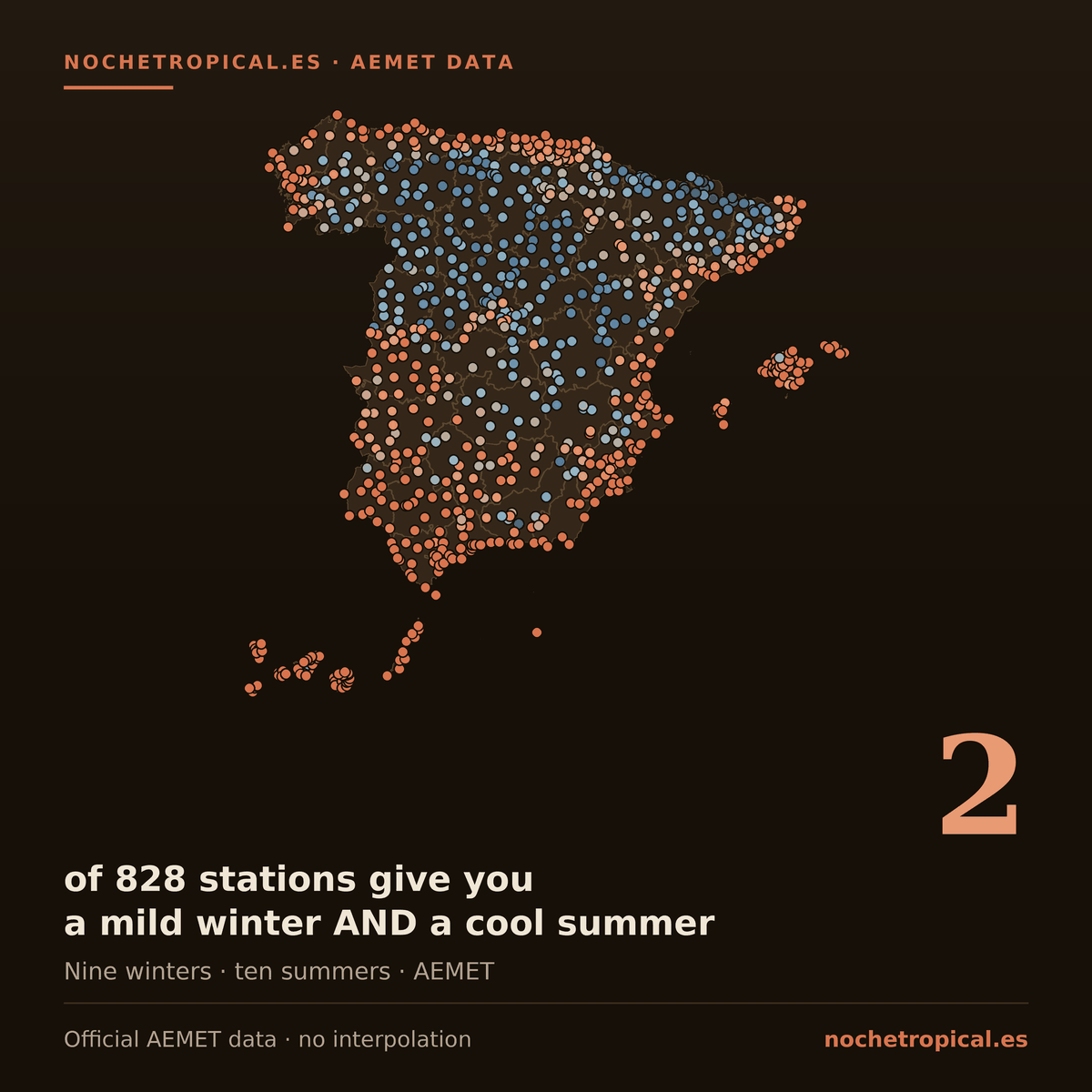
Across 828 weather stations with both records, the correlation between winter heating nights and summer tropical nights is -0.71 (Spearman). In plain English: the milder the winter, the worse the summer night — almost without exception.
Mainland & BalearicsCanary IslandsNot beaten on both counts
Each dot is one AEMET weather station, 9 winters and up to ten summers. The dashed box is the climate everyone says they want: under 40 heating nights and under 30 tropical nights. 17 stations of 828 are inside it — and not one of them is on the mainland or the Balearics.
Of the stations on the mainland and the Balearics, 12 have a winter mild enough to stay under 40 heating nights. 542 have a summer quiet enough to stay under 30 tropical nights. None has both.
And that is not an artefact of taking the middle year. We checked each winter against the summer that followed it — 5,850 station-seasons across 8 years — and the count of places with both was 0. Every single year.
The 17 stations that do manage both are, every single one of them, in the Canary Islands. That is not a quirk of the data: it is what 28° of latitude and an ocean with no seasons do to a thermometer.
A place is “not beaten” if no other station in Spain has both a milder winter and a cooler summer than it. That is the honest way to answer “where is the best climate in Spain”: not a winner, but a set of options nobody improves on. That set has 2 members: San Andrés y Sauces (0 heating nights, 4 tropical) and Estaca de Bares (75 heating nights, 0 tropical).
Everything else in the country — every costa, every city, every mountain village — is beaten by one of those two on both counts at once.
San Andrés y Sauces, on the north-east of La Palma, 362 m up: 0 nights below 10 °C in a typical winter, 4 tropical nights a year, and not a single frost in 8 winters. Its worst winter needed the heating on 2 nights.
The catch is in the same table: 51 rainy days per winter and only 104 days out of 151 warm enough to eat outside. This is the windward, cloud-catching side of the island. The climate is extraordinary; the weather is often grey. We publish both numbers because the second one is what a brochure would leave out.
Same stations, same method. Heating nights are nights below 10 °C between 1 November and 31 March (out of 151). Terrace days are days that reach 18 °C. Tropical nights are nights that never drop below 20 °C, counted over the whole calendar year, not just summer. Green means comfortable, orange means it costs you.
| Place | Heating nights | Terrace days | Rainy days | Tropical nights/yr |
|---|---|---|---|---|
| The winter-sun coast Mild in January. Now look at August. | ||||
| MalagaMálaga · 25 m | 24 | 85 | 20 | 109 |
| MarbellaMarbella · 2 m | 11 | 90 | 20 | 94.5 |
| EsteponaEstepona · 19 m | 24 | 89 | 31 | 63.5 |
| NerjaNerja · 169 m | 35 | 88 | 23 | 80 |
| CadizCádiz · 2 m | 25 | 83 | 34 | 107 |
| AlmeriaAlmería Aeropuerto · 21 m | 62 | 103 | 15 | 99 |
| AlicanteAlacant/Alicante · 81 m | 94 | 92 | 17 | 86 |
| BenidormBenidorm · 36 m | 98 | 84 | 16 | 79 |
| MurciaMurcia · 62 m | 105 | 104 | 16 | 91 |
| ValenciaValencia Aeropuerto · 56 m | 112 | 87 | 20 | 75 |
| Palma de MallorcaPalma, Puerto · 3 m | 58 | 77 | 30 | 111 |
| BarcelonaBarcelona, Drassanes · 11 m | 59 | 37 | 20 | 99 |
| The Canaries The only place that breaks the rule. | ||||
| Tenerife SouthTenerife Sur Aeropuerto · 64 m | 0 | 151 | 7 | 102 |
| LanzaroteLanzarote Aeropuerto · 14 m | 0 | 150 | 9 | 99 |
| Las PalmasLas Palmas de Gran Canaria, San Cristobal · 55 m | 0 | 144 | 18 | 127 |
| San Andres y Sauces (La Palma)San Andrés y Sauces · 362 m | 0 | 104 | 51 | 4 |
| The cool-summer north You sleep in August. You pay in January. | ||||
| A CorunaA Coruña · 57 m | 81 | 23 | 71 | 0 |
| Estaca de BaresEstaca de Bares · 90 m | 75 | 14 | 65 | 0 |
| SantanderSantander · 52 m | 92 | 25 | 57 | 5 |
| San SebastianDonostia / San Sebastián, Igeldo · 250 m | 109 | 26 | 69 | 4 |
| BilbaoBilbao Aeropuerto · 42 m | 121 | 48 | 61 | 6 |
| VigoVigo · 120 m | 97 | 30 | 71 | 4 |
| Inland cities The worst of both, by design: no sea to soften it. | ||||
| MadridMadrid, Retiro · 667 m | 140 | 16 | 31 | 49 |
| SevilleSevilla Aeropuerto · 34 m | 99 | 89 | 26 | 56 |
| GranadaGranada-Cartuja · 775 m | 141 | 69 | 28 | 39 |
Median of the series, never the mean: averaging a brutal winter with a gentle one invents a mild one that never happened. Each row names its weather station — where a city has several they can differ a lot, and that difference is the urban heat island, not an error.
Take the two ends. Marbella asks you to heat the house on 11 nights a winter and gives you 90 terrace days — then hands you 94.5 tropical nights a year. A Coruna gives you 0 tropical nights — and asks for 81 heating nights, leaving you just 23 terrace days.
Neither is “the best climate in Spain”. They are two different bargains, and the honest question is not which is better but which discomfort you mind less: a cold evening you can fix with a jumper and a radiator, or a hot night you cannot fix at all without air conditioning.
If it is the heat you mind, our coolest towns to sleep in summer ranks the places where the night still cools down. If it is the cold, Spain’s mildest winters and the frost-free towns do the opposite.
Source: daily climate records from AEMET, Spain’s national weather service. Winter seasons run 1 November to 31 March and are labelled by the year they start; a season counts only if the station recorded at least 120 of its 151 days. 9 seasons, 2017-18 to 2025-26. Summer figures come from the same daily records over whole calendar years.
Why 1 November and not December: because November and March are not a shoulder season. They are 40.4 % of the winter days and carry 37.2 % of the heating nights — their fair share. Frost is different: only 22.8 % of it falls outside December–February.
Nothing is interpolated. Every figure comes from a real thermometer with a name. We do not model the weather between stations and we do not average stations together: if your town has no station, the nearest one is a neighbour’s reading, not yours.
This is climate, not a forecast. Nine winters describe what has been happening, not what next January will do. And it says nothing about anything other than temperature and rain — not wind, not humidity, not what a place costs, not whether you will like it.
More: all our English guides · coolest towns in summer · mildest winters · search 828+ stations.