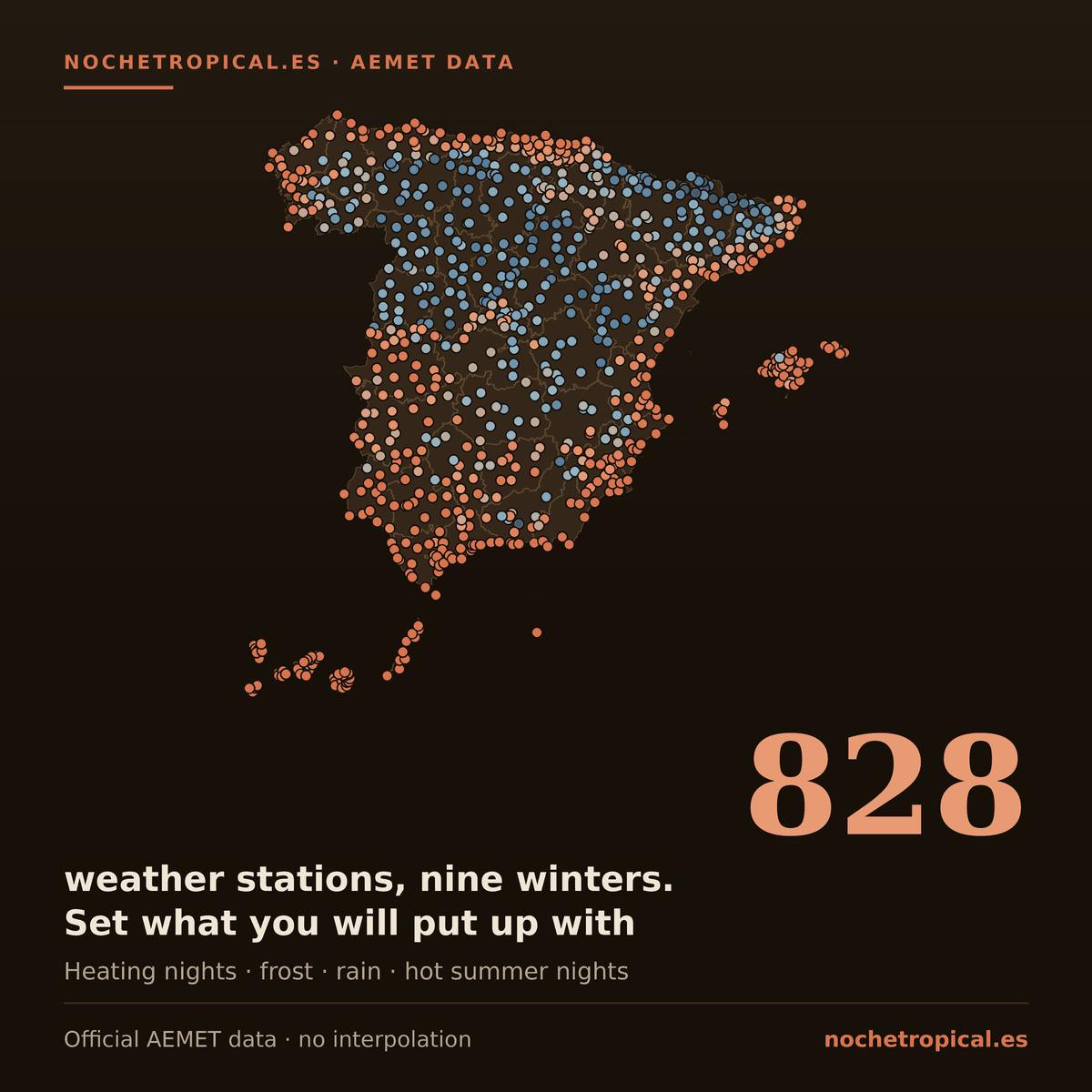
There is no single best place, because nobody wants the same things — and because the length of your stay changes which number is true. A fortnight anywhere in the south looks perfect. Three months is a different town. So this asks you three things: when you are coming, how long for, and what you will actually put up with. Then it shows you which measured places cleared it, and in how many of the last nine years.
It started as a winter tool and the address still says so, but it now answers for all twelve months: a week in August where you can sleep is the same question asked the other way round.
When you come and how long you stay change the answer, so they come first. Huelva gives you 14 terrace days out of 14 in a November fortnight — and 53 out of 90 over three months, with one stretch of 25 days running without a single one. Same town, same month, different question.
Showing 3 months from 1 November. Every limit below is counted inside that window, and every measured place starts on the list.
Every measured place in Spain is on the list right now. Each slider you move takes some out.
Loading the weather stations… If nothing appears, your browser has JavaScript switched off — the tables on Spain’s mildest winters and the coolest towns work without it.
Each of these is a normal web address with the month, the length of stay and the limits already set. Open one, then move things from there. They are also the easiest thing to send someone — or to be sent.
Your whole search lives in the address itself, so nothing is stored about you and no account is needed. Two people opening the same link see the same list.
All of them come from the daily records of AEMET, Spain’s national weather service, and every one of them is counted inside the window you picked — not over a season or a year. They are medians, never means. Averaging a brutal winter with a gentle one invents a mild one that never happened.
Two things this does not do. The window always starts on the 1st of the month: a fortnight from the 20th of June is not the one measured here. And a year only counts when AEMET measured at least 90 % of that window’s days, so some places carry fewer than nine years — the last column says how many. A missing day is never counted as a good one.
Every row is one real thermometer. Nothing is interpolated and no stations are averaged together: if your town has no station, the nearest one is a neighbour’s reading, not yours. Where a city has several stations they can differ a lot — that gap is the urban heat island, not an error.
Why the trade-off is so hard to beat, with the whole cloud of stations on one chart: the best climate in Spain, year round. And why a long stay is decided by the worst run and not by the median: spending a winter in Spain.