Where do you actually sleep well in a Spanish August? These are the 14 mountain towns, grouped by region, where AEMET records almost no tropical nights — the nights that never drop below 20 °C. Real data, ten summers, no marketing.
~0
tropical nights a year in the coolest villages (e.g. Puerto del Pico)
84
a year in the worst spot for sleep, San Sebastián de la Gomera (Santa Cruz de Tenerife)
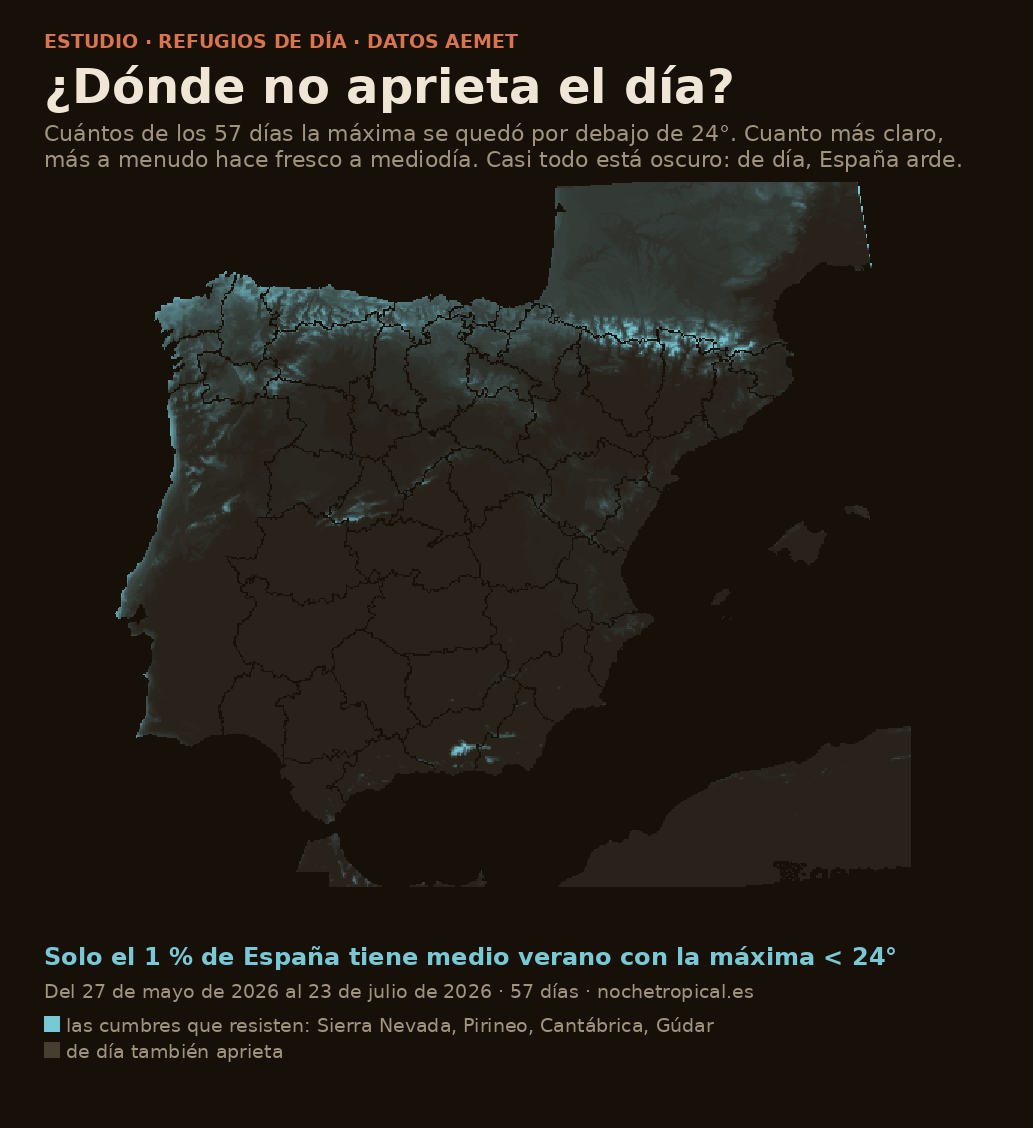
The teal islands are the highland interiors that stay coolest by day — and coolest by night. Each town below sits inside one of them.
Peaks that stay cool by day: Sierra Nevada, the Pyrenees, the Cantabrian range, GúdarHot by day too
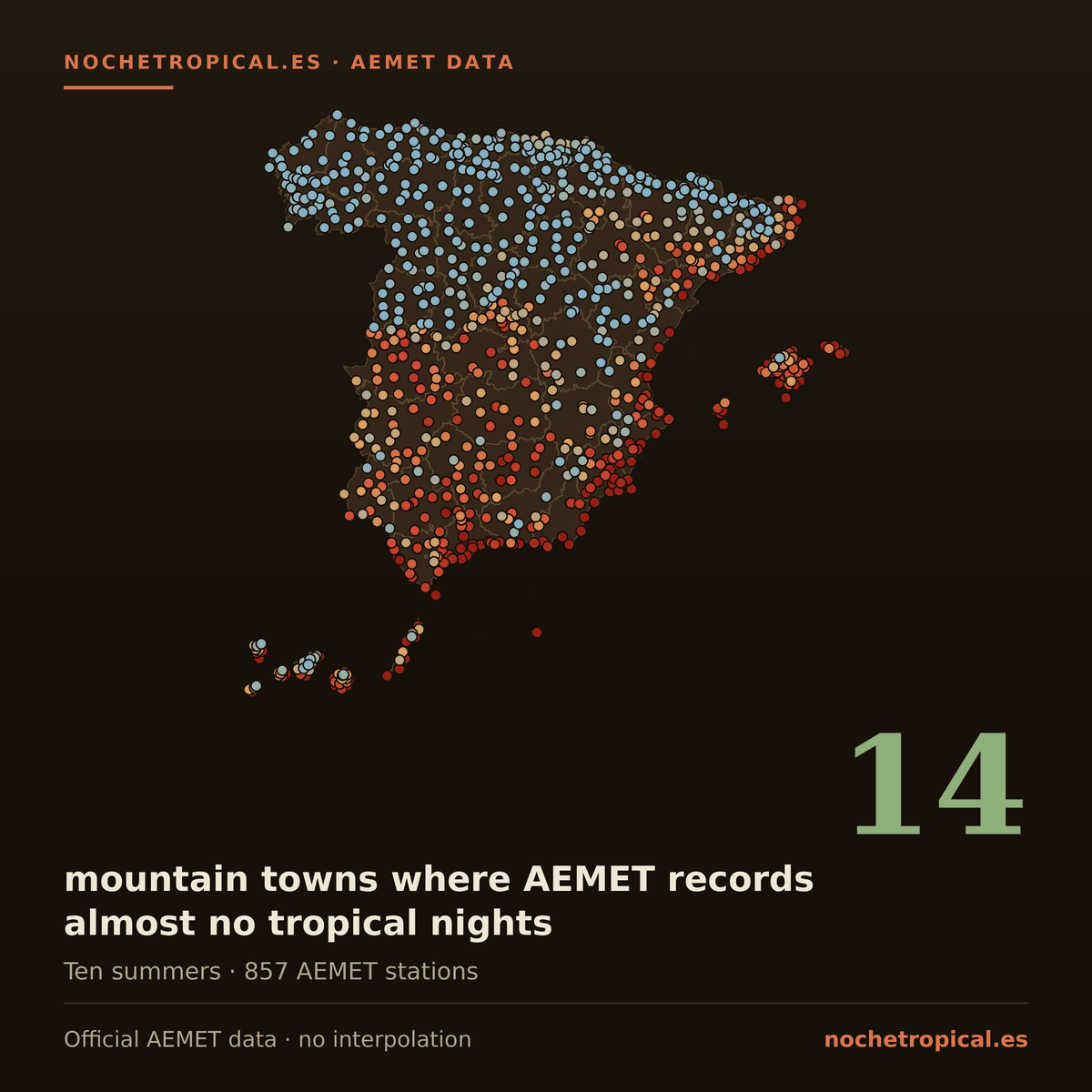
The 857 AEMET stations by tropical nights per year. The cool north and the mountain interior against the Mediterranean coast. Source: AEMET.
The town cards open their Spanish data page — the numbers read the same in any language, and your browser can translate the rest. A fully English destination guide is on its way.
The summer switch
Stare at the map without following it with your eyes. When the heat goes out, what stays lit are the 83 AEMET weather stations that record no tropical night at all in a year. It is the trick that found Pluto: the eye compares badly, but it spots change like nothing else.
Hover or tap any dot to find out which one it is.
Every dot is a measured station, not an interpolation: the 83 in our ranking with zero tropical nights a year across the summers of 2017–2026. Source: AEMET.
The Pyrenees
Aragón & Val d'Aran
Spain's highest mountains. In these alpine valleys the night barely registers a tropical night all summer — you will want a blanket even in August.
Teruel's high plateau is the poster child of the Spanish coolcation, with the sharpest day-to-night contrast in the country: scorching noons, genuinely cold nights.
Where can you sleep with a blanket in Spain in summer?
In the highland interior between roughly 600 and 1,700 m: the Pyrenees, the Sierra de Gúdar in Teruel, Gredos and Guadarrama, the Cantabrian Mountains, Sanabria and the Soria highlands. These towns record almost no tropical nights.
What is the coolest town in Spain to sleep in summer?
By average summer overnight low, Puerto del Pico (Ávila, 1.285 m) is among the coolest, at about 6.7 °C — and effectively zero tropical nights a year.
Are these good places for a coolcation?
Yes — they are the natural cool-climate destinations of Spain. Many sit inside national parks (Ordesa, Aigüestortes, Picos de Europa) or ski areas that reinvent themselves in summer as an escape from the heat. Cool days, cold nights, no crowds.
Is a town's climate the same as a hotel's temperature?
No — and we are careful about that. The data describe the outdoor climate of the town from AEMET stations: if the night cools down outside, sleeping is easier. It does not measure any individual building's interior.